
Nearly twenty-five years have passed since the people of Gander and other areas in Newfoundland and Labrador welcomed thousands of stranded airline travelers following the events of September 11.
Their kindness has prompted numerous books, films, and the musical Come from Away, yet this was not the first occasion when the residents of Newfoundland and Labrador extended their hospitality to strangers in times of crisis.
One night in July 1828, fisherman George Harvey was strolling along the deserted beach at Isle aux Morts when he noticed a keg floating in the surf, indicating that a nearby ship had likely sunk.
At first light the following day, he set out with his 17-year-old daughter Ann and 12-year-old son Tom in his small boat to search for the wreckage.
After several hours, they discovered the Despatch. Although the vessel had hit a rock, the majority of its two hundred passengers had managed to reach a nearby reef, where they were sheltered together against the harsh wind and rain “like sea birds.”
Over the course of three days, the Harvey family worked tirelessly, rescuing the passengers one at a time and transporting them to safety on the shore.
However, their efforts were far from over.
For two to three weeks, while awaiting the arrival of a relief ship, the Harvey family took care of the 163 survivors in their home and makeshift accommodations.
Surveyor Joseph Jukes, who stayed with the Harveys a decade later, reported that their food supplies “were so completely exhausted, that [they] were compelled to live chiefly on salt fish, with neither bread, flour, butter, nor tea, during the whole of that winter.”
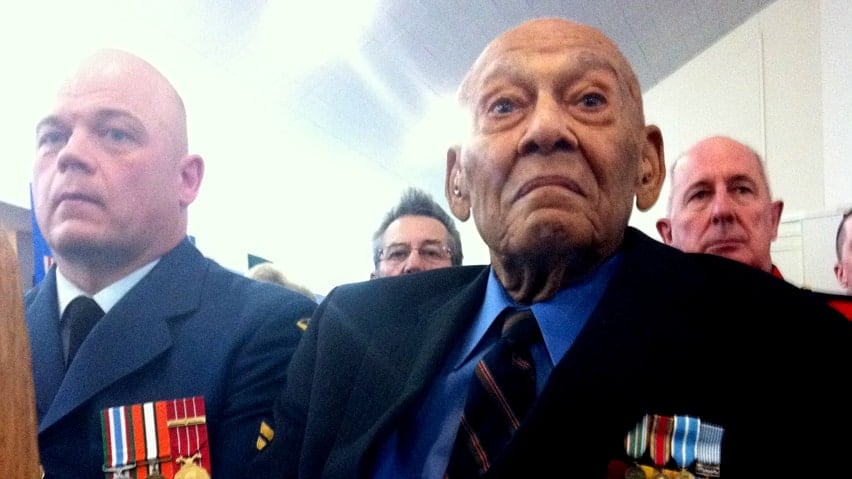
Lanier Phillips’ experience of receiving the same treatment as white survivors after the USS Truxton sank near St. Lawrence motivated him to become a civil rights activist. (CBC)
A different shipwreck during World War II had significant repercussions. When the American destroyer USS Truxtun grounded on the Burin Peninsula in February 1942, eighteen-year-old Black sailor Lanier Phillips leapt from the ship into the icy waters slick with oil.
He later regained consciousness in the small town of St. Lawrence, where local residents had carefully laid the survivors out on tables, removed their soaked garments, and were cleaning the oil off their bodies.
Raised in Georgia amidst the Ku Klux Klan’s influence, Phillips admitted he felt more vulnerable being exposed in front of white women than while he jumped into the sea.
“One lady held my hand,” he remembered, “and she said, ‘Gee, this poor fella… the oil is all in his pores.’”
Phillips responded, “That’s the colour of the skin. You can’t get it off.”
The woman, Violet Pike, had never encountered a Black man before. She invited Phillips to her home, fed him soup with a spoon, and helped him to bed.
“I had always thought that all Caucasians were racists and bigots,” Phillips reflected. “Well, they showed me there were people in the world that were not.”
This experience propelled Phillips to challenge segregation and pave the way for Black sailors in the U.S. Navy.
He became the navy’s first Black sonar technician in 1957 and later pursued a groundbreaking civilian career as an oceanographer. He was active in the civil rights movement and participated in marches with Martin Luther King Jr. in Selma, Alabama.
In his later years, Phillips traveled across North America sharing his story about that fateful night in St. Lawrence, his career, and his vision for racial equality.
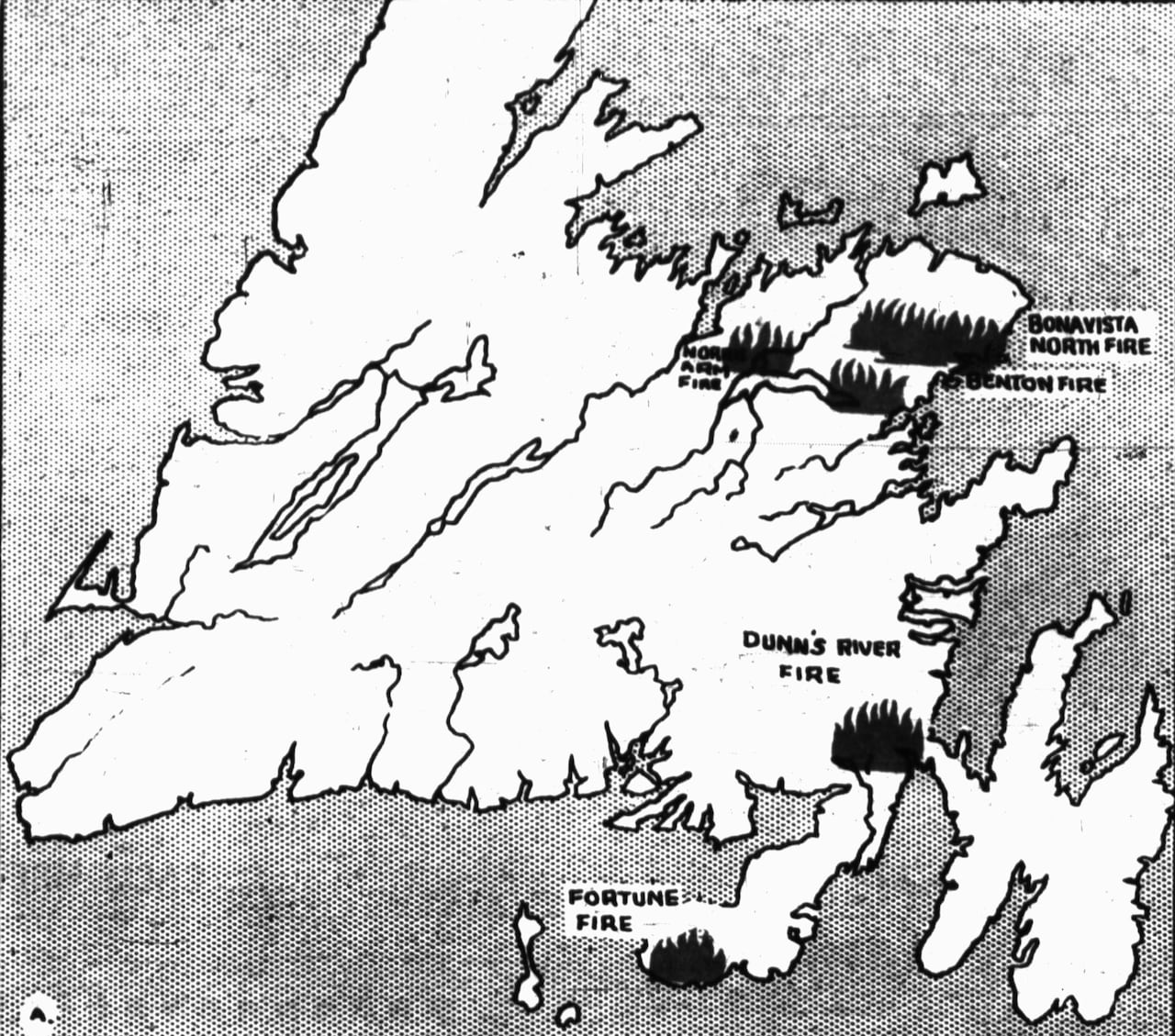
In September 1961, hundreds of residents had to evacuate Terrenceville due to the Dunn’s River wildfire. (Evening Telegram/Memorial University Digital Archives Initiative)
Two decades after the USS Truxtun sinking, thousands of Newfoundlanders faced evacuation during intense wildfires in 1961.
The town of Terrenceville on the Burin Peninsula was engulfed in smoke. While local men remained to combat the fire, 450 women and children were transported in the dead of night to Bay L’Argent.
Telegraph operators stayed awake all night coordinating the rescue, and every car owner in the Marystown area was roused to drive 60 kilometers to collect the evacuees.
“Within one hour, 40 cars were on the road,” reported the Evening Telegram, “and in less than three hours, 200 evacuees had gathered in Marystown’s St. Gabriel’s Hall, where they were provided with hot drinks and sandwiches.”
After receiving nourishment, the evacuees were welcomed into private homes across Marystown, Fortune, and Grand Bank.
E. P. Reddy, the then-mayor of Marystown, described the community’s response as a “spontaneous outburst of charity towards a neighbour in time of dire need.”
Reflecting on the event, Reddy mistakenly believed that such an act “may never be surpassed in the history of our island,” unaware of what was to come in 2001.
Is Newfoundland and Labrador genuinely more hospitable than other regions?
Most cultures hold hospitality in high regard. The moral obligation to assist those in need is integral to the adaptability and resilience of human societies.
However, this does not imply that every culture expresses hospitality in the same manner. Some communities prefer structured hospitality, with guests invited and activities prearranged, while others favor spontaneous hospitality, welcoming unexpected visitors and drop-ins.
In her book Foreign to Familiar, Sarah A. Lanier posits that structured hospitality is more prevalent in colder regions, while spontaneous hospitality thrives in warmer climates, as mild weather promotes outdoor socializing and open-door customs.
Severe environments, where mutual assistance is vital for survival, can also nurture a welcoming demeanor.
Hospitality is a cherished virtue among the Bedouin, who have traditionally thrived in desert conditions. Newfoundland and Labrador’s unpredictable climate and rugged landscapes may have fostered a similar spirit of hospitality.
People living in challenging environments may also encounter more opportunities to showcase their hospitality. The turbulent North Atlantic, for better or worse, has provided Newfoundlanders and Labradorians with numerous chances to assist survivors of shipwrecks.
Regardless of the reasons, tales of strangers finding a welcoming hand during dire situations can inspire everyone, like Lanier Phillips, to recognize the good in humanity.
Download our free CBC News app to receive push alerts for CBC Newfoundland and Labrador. Sign up for our daily headlines newsletter here. Click here to visit our landing page.

