
Dominic LeBlanc, Canada-U.S. Trade Minister, stated that reaching an interim agreement with the Trump administration could potentially initiate formal discussions to reassess the trilateral trade agreement involving Canada, the U.S., and Mexico.
In an interview with CBC’s Power & Politics, LeBlanc indicated that this interim agreement would likely incorporate some degree of Section 232 tariffs on steel, aluminum, automobiles, and lumber, though at reduced rates. He expressed optimism about continuing dialogues regarding these tariffs during the formal discussions pertaining to the Canada-U.S.-Mexico Agreement (CUSMA) review.
“The Americans have made it evident that if we can agree on lowering the 232 and 338 tariffs, we can also commence the formal review process as outlined in the CUSMA agreement,” the minister conveyed to host David Cochrane.
LeBlanc pointed out that other nations have negotiated deals with the U.S. that still included some tariffs, emphasizing that the aim is to lower the 232 tariffs sufficiently for those industries to compete effectively on a global scale.
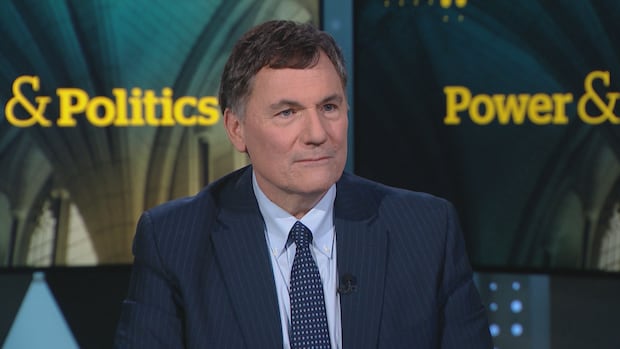
Power & Politics speaks with Canada-U.S. Trade Minister Dominic LeBlanc after he briefed the prime minister’s economic advisory council. Canada is now seeking to reach an interim tariff arrangement with the White House by the end of the year while negotiators seek relief on steel, aluminum, auto, lumber and other sectors.
“We need to improve our comparative standing,” he remarked. “However, we must be realistic with Canadians—some of these tariffs will persist in those specific sectors. They just need to be at a level that ensures the long-term economic sustainability of these industries.”
LeBlanc mentioned that the government aims to eliminate the 338 tariffs, which were implemented by Trump in September. He noted that while progress is being made towards an interim agreement with the U.S., more work remains to be done.
Earlier on Thursday, the minister addressed members of the federal government’s Canada-U.S. advisory committee. According to CBC News, discussions during that meeting indicated that the government is striving to finalize an interim trade agreement with the Trump administration by the year’s end.
After the last round of trade negotiations collapsed in August, U.S. President Donald Trump warned of imposing higher tariffs on Canadian automobiles, auto parts, and steel starting January 1.
Not a hard deadline: committee member
Committee member Valérie Beaudoin cautioned that the goal of reaching an agreement by the end of the year is not a strict deadline.
“It might happen quickly, but it could also take longer. We know that dealing with Donald Trump—at least in my view—is not always straightforward or easy,” Beaudoin shared with CBC News Network host Andrew Nichols.
LeBlanc later echoed Beaudoin’s sentiments regarding the timeline for an agreement.
“The objective is to secure the best possible deal for Canada as swiftly as we can,” he informed Cochrane.
“If it takes until January or February to finalize that deal, we are prepared to do that work.”
Jean Simard, another advisory committee member and head of the Aluminium Association of Canada, remarked to CBC News that the current moment is “the ideal time” for Canada to negotiate.
“Next year, a new Congress will be inaugurated, along with a new Senate, both with Democratic majorities—though they cannot overturn a [presidential] veto. Nevertheless, they will influence a portion of the agenda,” he noted.
The president’s Republican Party faced significant losses in the recent U.S. midterm elections, and some Democrats have committed to working towards eliminating tariffs on Canadian products once they assume control of the U.S. Senate and House of Representatives.
However, Flavio Volpe, president of the Automotive Parts Manufacturers’ Association and a member of the advisory council, informed CBC News that “it seems the dynamics in Congress have not yet reached the negotiating table.”
“The question arises: Is this the optimal time to strike a deal with an administration that may want to resolve the issue independently, without appearing coerced by the new Congress? Or is this an opportunity for the administration to contest Congress and demonstrate that they are truly in control?” Volpe pondered.
“From my perspective, it appears that various factions within this administration hold differing opinions on the matter.”
LeBlanc cautioned that Canada should not perceive the Democrats’ control of Congress as a “magic bullet” that will eliminate U.S. tariffs.
-
‘If the U.S. doesn’t want to do a deal, we’re busy,’ Carney says
-
Canada’s trade with China isn’t U.S. president’s top concern: Carney
Prime Minister Mark Carney is returning to Ottawa following a nine-day trade mission to Europe and Asia.
Addressing the Dealbook summit virtually from China on Wednesday, Carney mentioned that Canada continues to face “a range of issues” regarding trade with the U.S.
The prime minister indicated that there had been advancements towards an agreement in recent weeks but emphasized that they have yet to reach the point of formalizing any agreements.
Carney met with Trump during the Asia-Pacific Economic Cooperation (APEC) summit in China—a conversation he described as “reasonably direct,” though it did not yield any trade breakthroughs.
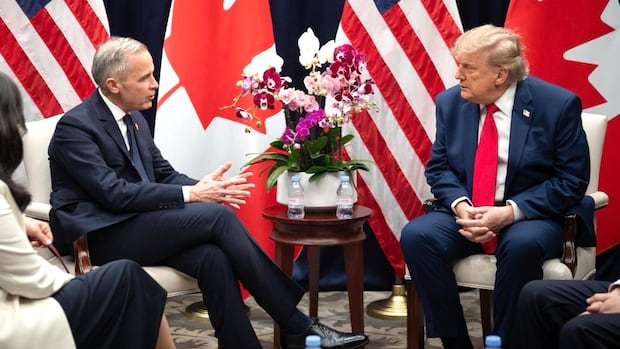
At the APEC summit in China, Prime Minister Mark Carney met face-to-face with U.S. President Donald Trump for the first time since trade talks fell apart. Carney, who secured a number of global deals at the summit, said if the U.S. still isn’t ready for a deal, ‘we’re busy.’
During his recent trip, Carney negotiated free trade agreements with the Philippines and the 11-nation ASEAN bloc, achieving significant market access for Canadian commodities in exchange for allowing a limited number of Chinese electric vehicles to be imported at lower tariff rates and modifications to import regulations for specific Chinese steel and aluminum products.
“We would prefer to finalize a deal. If the U.S. is not inclined to do so, we are occupied with other opportunities,” Carney stated to the audience at the summit in New York.
Peter Navarro, a leading trade adviser to Trump and a critic of Canada, condemned Carney on Wednesday for pursuing a more open trade relationship with China.
“Are you truly threatening to leverage China against the U.S.? This is incredibly offensive,” Navarro remarked in a social media post.
The White House official reiterated his criticism of Canada’s negotiating approach on Thursday.
“The arrogance and dishonesty displayed by Ottawa concerning trade and their misinterpretation of their position is remarkable,” he stated.
“They resemble a high school team challenging the New York Knicks. That situation does not end favorably for Canada.”

