
It’s hard to overlook the hundreds of large, white blocks stacked several feet high near the new overpass construction at the Banwell Road and E.C. Row Expressway interchange.
Resembling oversized Lego pieces, these blocks serve a serious purpose.
Known as Expanded Polystyrene (EPS) geofoam blocks, the City of Windsor has indicated that these materials are being utilized to construct the embankments adjacent to the new overpass.
“EPS blocks are incorporated into construction projects to prevent base ground settlements through a method called ‘compensated foundations,’” explained Jill Braido, a spokesperson for the city, during an interview with CBC News.
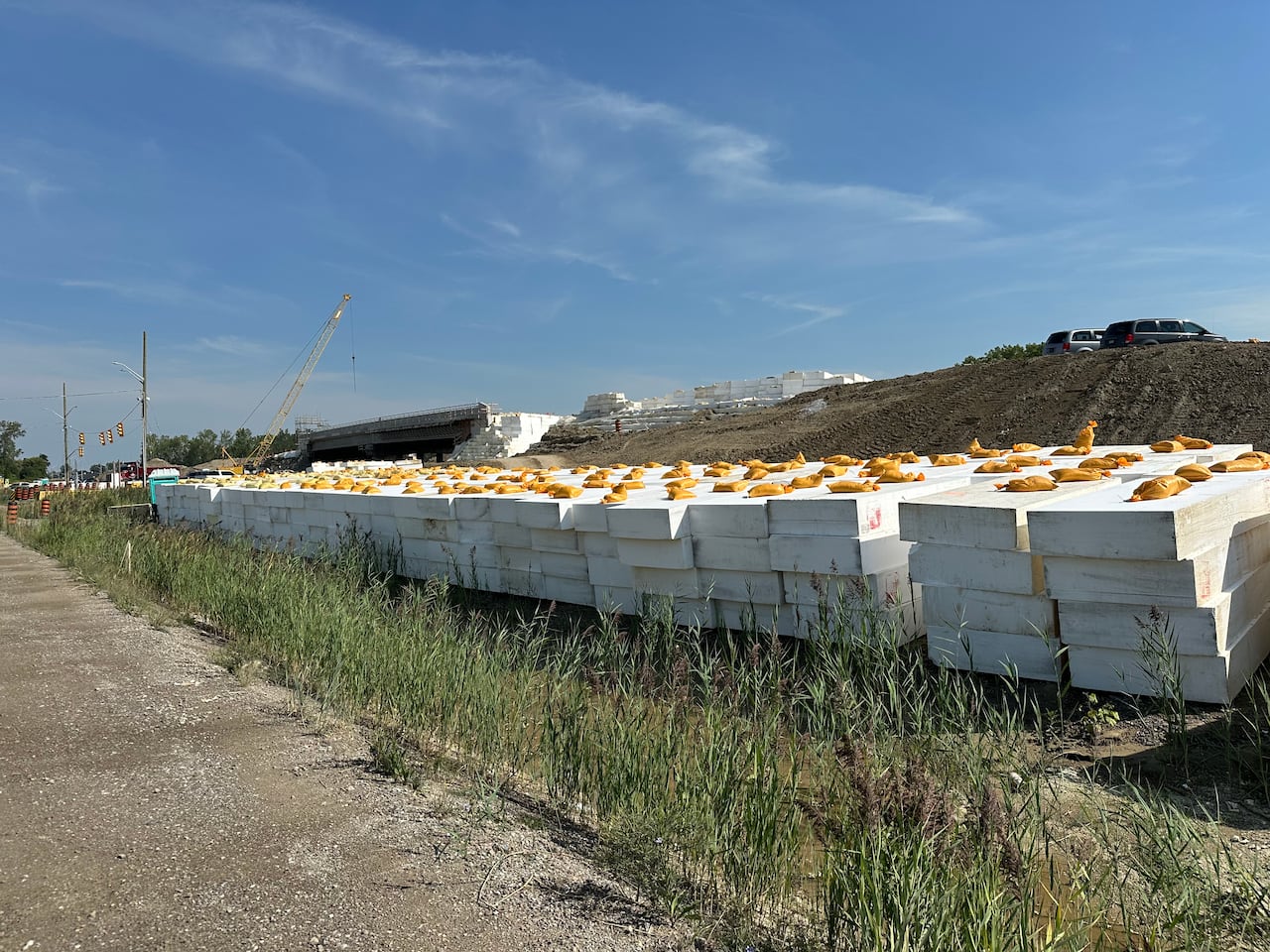
According to the city, the Expanded Polystyrene (EPS) geofoam blocks are utilized to prevent “base ground settlements.” (Darrin Di Carlo/CBC)
Instead of constructing the bridge overpass approaches directly on traditional soil, the construction teams are substituting a considerable amount of dirt with EPS blocks before placing the final road surface on top, as Braido clarified.
Mina Lee, a civil engineering professor at the University of Windsor, shared insights during an interview with CBC Radio’s Windsor Morning on Thursday. She noted that geofoam is chosen over dirt because it is 100 times lighter than soil, which can be too burdensome for the underlying ground.
“[The geofoam blocks] alleviate the weight that is exerted underground,” Lee stated. “In Windsor, we have an abundance of clay, which is prone to settling over time, so this helps in reducing excessive settlement as time passes.”
Braido highlighted that this technique will guarantee the “long-term stability of the bridge overpass approaches while also providing lower overall labor costs compared to using heavy traditional soil or gravel fill as the foundational material.”
This method is becoming a common practice in Windsor’s road infrastructure.
The city noted that EPS blocks were also employed in building the Gordie Howe International Bridge, which opened for vehicle traffic in July.
Unlike regular styrofoam that easily disintegrates, there’s no concern about these blocks breaking under stress. Lee explained that the geofoam material is highly dense, produced in a controlled setting, and engineered to endure the heavy loads it is meant to support.
There are also environmental advantages.
“Due to [the geofoam blocks’ lightweight nature], they are very easy to transport, whereas moving dirt and soil requires multiple trips to the construction site,” Lee remarked. “This aspect helps in reducing the greenhouse gas emissions associated with transportation.”
Furthermore, she pointed out that the blocks are crafted from recycled materials, indicating that “they can also be recycled after the infrastructure’s lifespan.”
Regarding the expected lifespan, Lee indicated that geofoam can last between 50 to 100 years.
Tag: rewrite-pending

